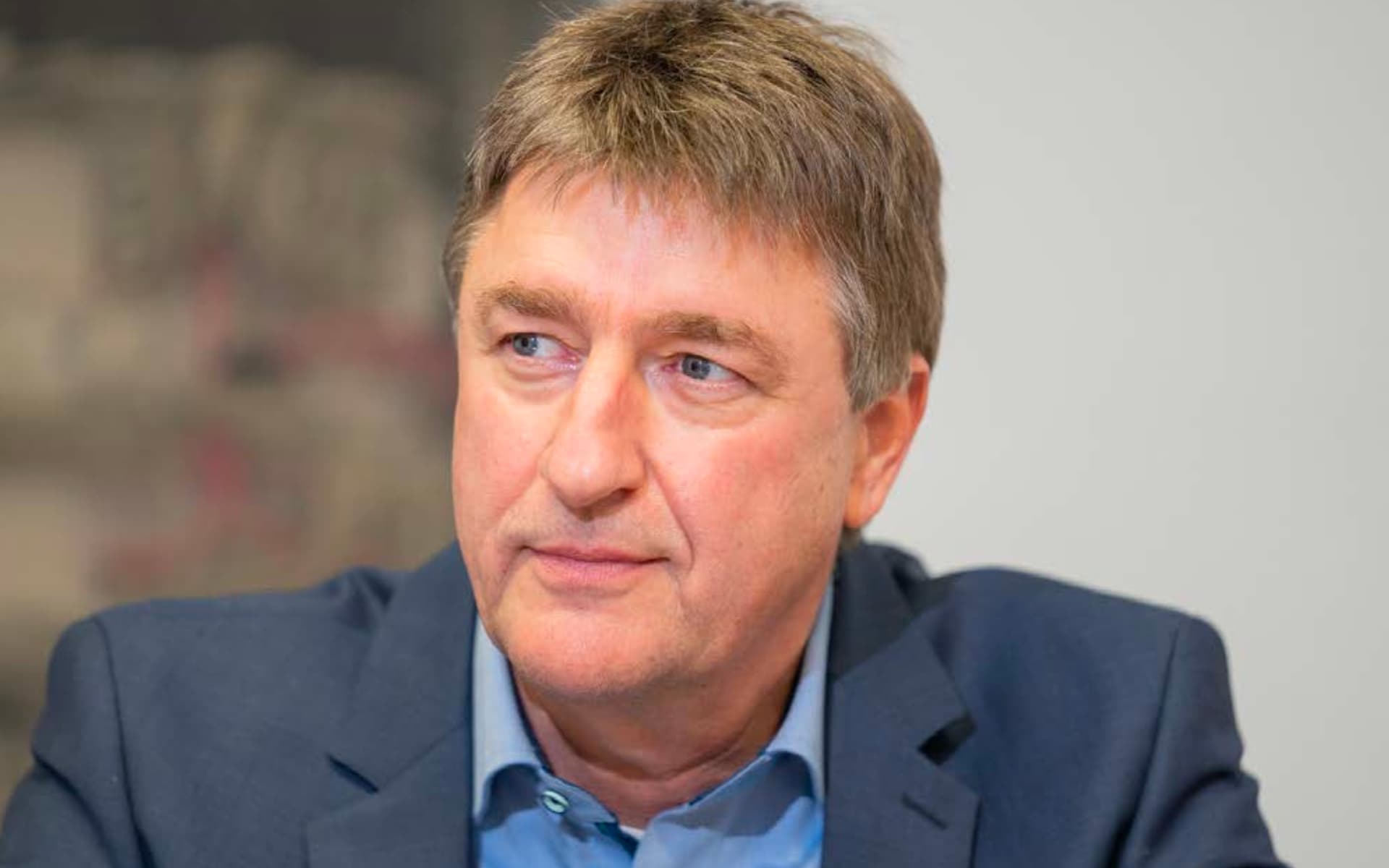
Christof Senk, Managing Director of ELBRO AG, in conversation with Pascal Grolimund of Otto Fischer AG
Buildings are becoming increasingly automated. Christof Senk, Managing Director of Elbro, sees his company in this market segment - not as a provider of large integrated solutions, but rather as a developer of clever products for the niche market.
The interview was published in the eco2friendly magazine Spring/Summer 2022.
The focus of this issue is on building automation. What does this mean for Elbro?
We don't offer large integrated solutions, but have specialised in niche solutions - in other words, clever solutions that are very useful in buildings. Motion and presence detectors in stairwells, for example. We are also represented in the heating/air conditioning sector with the SMS Butler. We also have a wide range of energy-efficient lights for interiors, but also for outdoor lighting in the garden. In addition, we provide a wide range of products for industrial environments, ranging from high-bay LED spotlights to special lighting, for example in the area of explosion-proof lighting or food lighting. Our range also includes a sensor that monitors CO2 emissions in indoor air. If the critical limit values are exceeded, ventilation is recommended or automatic ventilation is carried out using LEDs or external warning lights and acoustic signals. This is particularly important in the current climate.
One of the measures required to achieve the Energy Strategy 2050 is to optimise energy efficiency. However, building automation systems also give the impression that, on balance, their use consumes more electricity than is saved. What do you say to this?
In fact, gadgets are offered in the field of building automation that are less useful; for example, a fridge that orders food on its own. Our products, on the other hand, focus on solutions that save resources, such as heating and hot water, which consume two thirds of the energy in a house.
The Elbro SMS butler is one of your highlights. What are its strengths?
The SMS-Butler is used for remote monitoring and remote control via the mobile phone network, which allows countless possible applications. For example, as a remote heating control in a chalet, for access control in buildings or in lighting control. In the food industry, for example, heating or cooling systems can be monitored and regulated in this way. In agricultural businesses, on the other hand, the Butler can be used to measure, monitor and regulate the ammonia content in the air in stables.
How much energy can be saved on heating thanks to a control system?
Last year, we were able to take part in the «Make heat simple» project launched by Energie Schweiz. The aim is to make heating easier to manage with the help of a remote control. In many holiday homes, for example, the heating is still on even when nobody is there. With a remote control such as the SMS-Butler, the heating can be reduced to a minimum when no one is using the home and it is heated to a comfortable temperature before anyone arrives. If a heat pump is used, slightly less energy can be saved than in properties with oil heating, which are often still found in holiday homes. But remote control makes sense for both variants. Incidentally, a lot of energy can also be saved with electric heating systems, which are often used on campsites, for example.
Digitalisation in construction is a much-discussed topic. How will this change the industry?
The topic of digitalisation will certainly change the industry. This can be seen not least in the fact that new apprenticeships such as that of building IT specialist have been created. I think the challenge of digitalisation is to evaluate which solutions are sensible and which are excessive. However, it is particularly important that where different trades interact, this is possible without problems and too many interfaces. A good overview is important in this respect, as everything must be considered in a networked way. Under these conditions, digitalisation is certainly a huge step forward. This can also apply to electromobility: Currently, the car is often parked in the garage and the battery is not used, although it still has great potential to utilise the energy sensibly.
The demands on electrical installation specialists have increased and programming skills are in ever greater demand. Do you feel this?
We realise, especially in support, that the level of expertise is still very different. For example, we have already received enquiries about how to connect 12 volts correctly, but at the same time we also answer detailed technical questions about programming.
Elbro has been involved in eco2friendly for years. What motivated you to take part?
We were one of the first partners of eco2friendly and greatly appreciate this collaboration. We were enthusiastic about the programme as soon as it was presented to us. After all, all of our energy-efficient lighting and control products fit in perfectly with the eco2friendly idea.
What do you do to save energy at home?
As a private individual, I try to keep my CO2 footprint low. Among other things, this means that whenever possible I don't shop online, but go to the market and support local businesses. It goes without saying that all the light sources I use are equipped with LED technology. And my next vehicle will certainly be an electric car.